Turnkey
Purchased through authorized channels with an EOL/PCN screen per line. Passives carry a 5–10% overage; date-code policy agreed before the PO.

PCB Assembly
Single- and dual-sided SMT plus through-hole on the same floor — and the same engineering team follows your build from prototype to volume. 01005 to 45 × 45 mm ICs, 0.25 mm BGA, IPC-A-610 Class 2 default or Class 3 on request.
Parameters
Checked at DFM against your actual BOM — not quoted from a best-case table.
| Parameter | Specification |
|---|---|
| Technology | SMT single/dual-sided, THT, mixed technology |
| Smallest passive | 01005 (0.4 × 0.2 mm) |
| Largest IC body | 45 × 45 mm |
| BGA pitch | From 0.25 mm, 100% X-ray |
| QFN pitch | From 0.3 mm |
| Placement accuracy | ±0.025 mm |
| Max board size | 460 × 500 mm |
| Workmanship | IPC-A-610J Class 2 default / Class 3 on request |
| Hand soldering | To J-STD-001 |
| Reflow profile | Programmable, 240–255 °C peak, lead-free |
| Order size | 1 to 100,000+ pcs |
| Standard build | 5–7 working days, turnkey |

DIP & THT
Two DIP lines run wave soldering for volume and selective soldering for mixed boards whose sensitive parts cannot survive a full wave. The SMT side stays on the same traveler, so one build record covers every joint.
Mini case: a mixed-signal board with 180 through-hole parts and a relay rated to 120 °C ran selective on the SMT panel — one pass, no second reflow, 99.4% first pass yield across a 400-pc lot.
Boards that need both worlds leave the line as one build: reflow, wave and selective recorded in the same traveler, so a single traceability file answers customer audits.
See the DIP floor >Sourcing & BOM health
Screened before purchase, verified on arrival, documented at shipment.
Purchased through authorized channels with an EOL/PCN screen per line. Passives carry a 5–10% overage; date-code policy agreed before the PO.
Your kits verified line-by-line against the BOM on arrival; shortages and date-code spread reported the same day, before scheduling.
Last-time-buy windows typically run 6–12 months, and some parts go EOL without a PCN. The BOM health check flags both, with alternate parts proposed and data-sheeted.
Batch and date-code records attach to every shipment; RoHS/REACH declarations on file. PPAP Level 1–3 packs available for automotive programs.
Test & inspection
Every board passes 100% AOI and X-ray on hidden joints before electrical test begins.
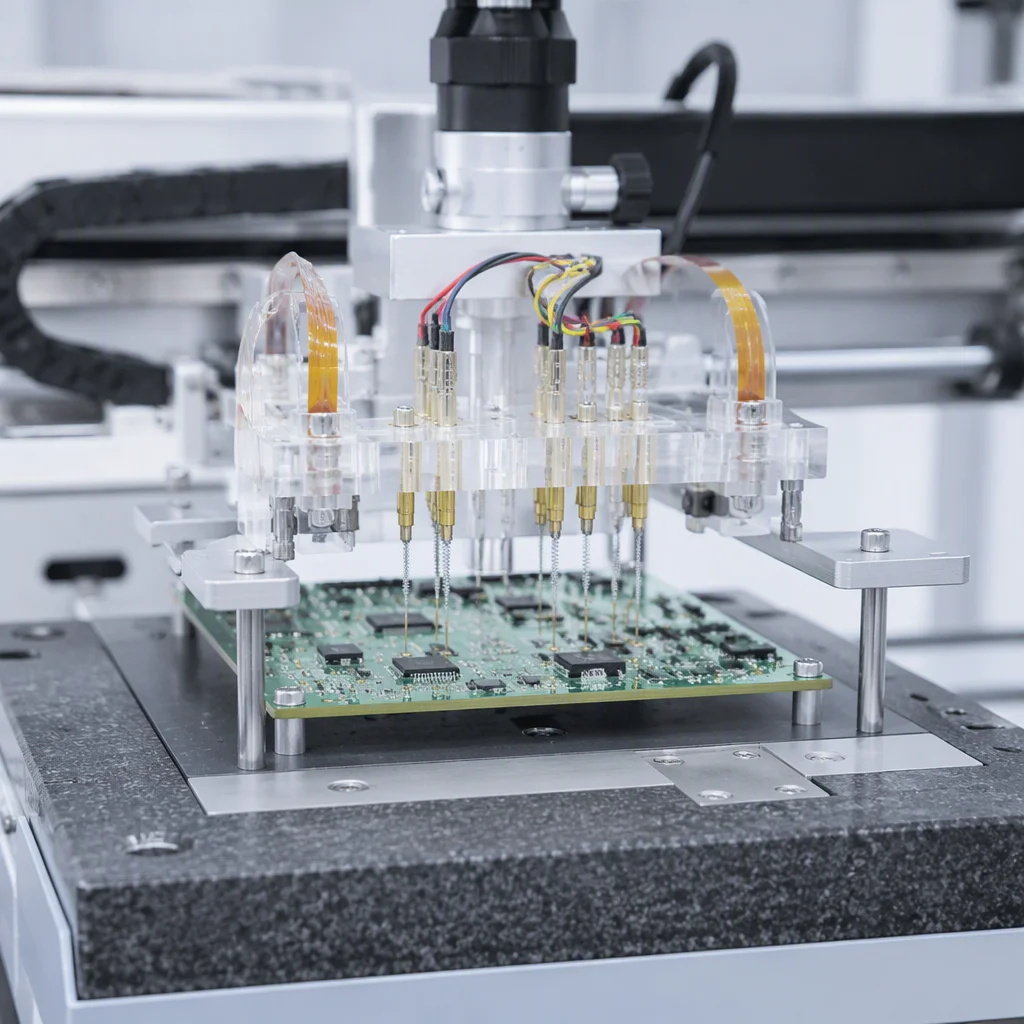
No fixture cost, programmed from your netlist — the right answer below ~50 pcs, where a bed-of-nails never amortizes.
Bed-of-nails fixtures for volume repeats; the fixture is amortized across builds and stored with your job file.
Functional bench test to your procedure, firmware flashing included; results logged per serial number.
Prototype to volume
300+ part numbers are introduced here every year — ramping is a repeat process, not a re-qualification.
Gerber + BOM in; DFM notes covering pads, stencil, panelization and BOM risk return with pricing in 1 business day.
Your part: confirm service level (turnkey or consignment) and quantities.
Sourcing with EOL screening, SMT and DIP assembly, 100% AOI plus X-ray on hidden joints; prototypes ship in 5–7 working days, 72 h for simple boards.
Your part: approve the DFM response and the acceptance class.
Volume runs on the same lines with the same stencil, programs and fixtures; the pilot report carries straight into the production traveler.
Your part: release the volume PO against the pilot report.